
Minotaur
Theseus, Part 4: Mess with the bull, get the horns, escape the horns, sail to freedom
Content warning: arranged marriage, animal sacrifice, death of an animal, animal gore, bestiality, mention of human sacrifice, killing of a monster, abandonment
Previously in the life of Minos:

Find the last two parts of Theseus’ story here:
Part 2

Part 3


The sons of Zeus and Queen Europa of Crete had been adopted by King Asterius on his marriage to Europa and he had raised her children as his own. One of these sons was Minos, who had inherited Asterius’ throne upon his death as he and Europa had had no further children. The Titan sun god Helios had then given his daughter Pasiphaë to Minos as a wife to solidify Minos’ position as the king of Crete and to forge a useful alliance with a powerful island nation.
Though their marriage hadn’t been borne of any love or attachment, children were nevertheless Pasiphaë’s duty to bear, so bear them she did. The king and queen had several children, four sons and four daughters: Catreus, Deucalion, Glaucus, Androgeus, Acacallis, Ariadne, Phaedra and Xenodice. However, even with such a prolific family and the blessing of his adopted father, Minos still felt as though his brothers, Rhadamanthus and Sarpedon, envied his position and power and that he therefore needed to prove himself as the true king of Crete.
Minos prayed to Poseidon, certain that if he could get the gods’ approval then he could prove his claim to the throne. He begged for a sign, anything to show his brothers that he was favoured by the gods and deserved his place as the head of the family. Poseidon heard his pleas and sent a snow-white bull to the island, instructing Minos that he should sacrifice it and would then be blessed by his favour, leaving his throne in no doubt.
Minos readily promised that of course he would do such a simple task, that the sea god’s will was his command. Minos sent word at once to his men to look out for a godly, snow coloured bull, desperate as he was to fulfil his promise. Before long, the bull was found and brought before the king but as soon as he laid eyes upon the magnificent beast, he determined that he couldn’t possibly put such a beautiful creature to death. He halted the planned ceremony and declared that he would have a moment alone to collect his thoughts.
He made his way to his own fields, bringing the god-sent cow with him, and found a cow in his herd almost as white but not quite as perfect, switching it quickly with the new bull. He recommenced the ceremony and sacrificed his own bull in the place of the one sent by Poseidon, hoping that the god wouldn’t notice his momentary act of greed.
The mortal Minos was no match for the deific sight of Poseidon, however, and the sea god immediately knew what treachery Minos had performed. Enraged, he schemed against the rapacious king and forced an unnatural lust in Queen Pasiphaë, meddling in her mind to enact his vengeance on her husband.
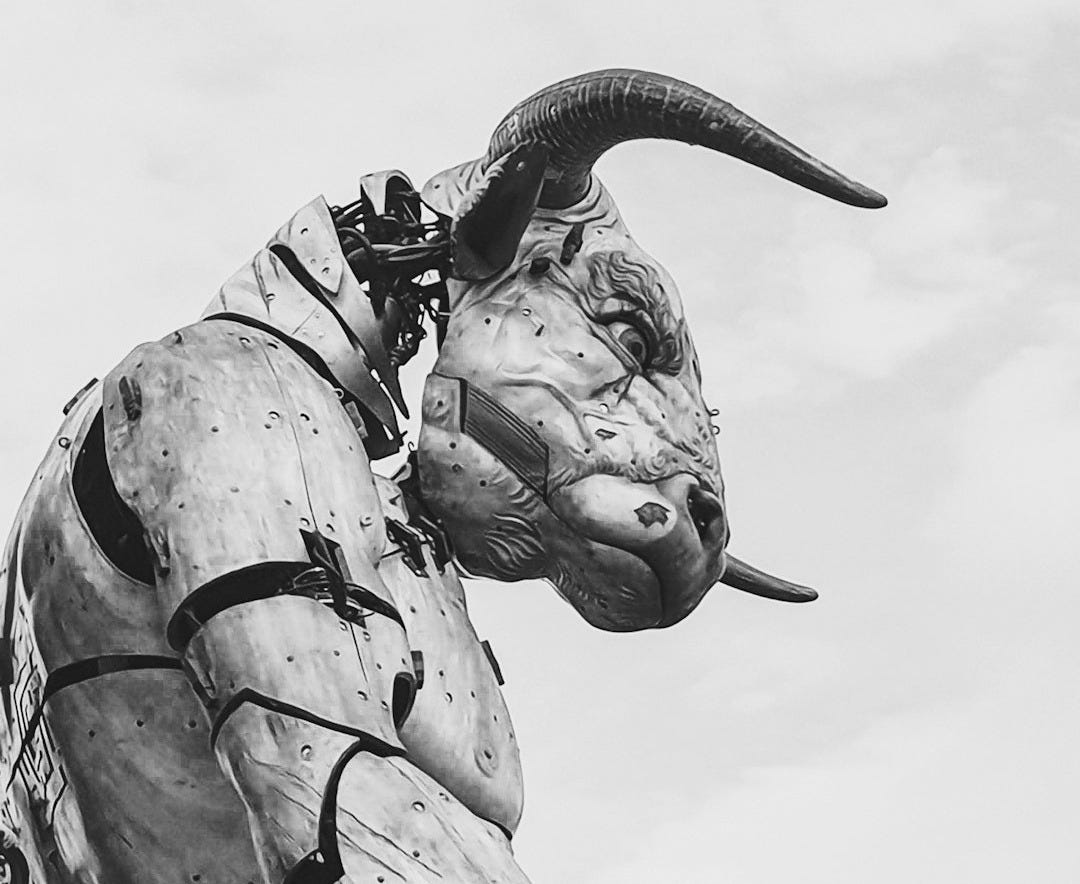
Pasiphaë awoke the day after the king’s trickery with an unfamiliar, instinctual urge to visit the palace’s cattle fields. Baffled by this but with no reason not to do so, Pasiphaë made her way to the dew-covered grasses where the cows were sleepily grazing. As soon as she set her gaze upon the bull sent by Poseidon, she fell instantly into some strange form of carnal fervour, a terrifying lust enveloping her at the touch of the gods.
At once repulsed by such unnatural and unwanted feelings, Pasiphaë let out a yelp of horror and fled back to the palace, seeking the safety of the walls to keep out her awful thoughts. Sitting with those roiling, horrible, desperate longings throughout the following days, at last the queen was driven to the edge of madness. Finally able to bear it no longer, Pasiphaë approached a master craftsman and inventor who had been working at the palace.
Daedalus had fled Athens and had been welcomed into the palace by Minos and Pasiphaë, so he was anxious to listen to the queen’s devastation and do what he could to help her. She poured out her hideous feelings to Daedalus and the artisan listened patiently, pitying the queen more and more with every word she uttered. At the end of her tale, he assured her that he could help her to satisfy her craving if she truly wished it. Torn between lust and horror, Pasiphaë found herself begging for his help, at once commissioning anything Daedalus could make to aid her.
The craftsman set out his tools and plans and ensconced himself in his workshop, building the frame of a cow big enough to allow the queen to sit inside. He then killed and skinned one of the palace’s herd and stretched the skin over the frame to complete the effect of the false cow. Pasiphaë, caught between disgust and a thrill of excitement, then climbed inside and the contraption was wheeled out into the pasture where the bull of her twisted affection was grazing.
The result of the following encounter between the queen and the white bull of Poseidon soon made itself clear; a new child was growing inside Pasiphaë, one she soon felt kicking with hooves where the baby’s feet should be. Horrified and sickened now that Poseidon’s addling was finished, Pasiphaë was stuck with the result of her awful dalliance that was all too soon pushing its way out from inside her.
The creature that emerged was half-man, half-bull, a flesh-eating monstrosity that thrashed and snapped at its mother and her attendants even as it was pulled from Pasiphaë. Daedalus, having anticipated some monstrous infant, trapped the beast in a strong cage he had forged and set to work on plans for a more long-term solution.
In some twist of irony, the creature was nicknamed the Minotaur, forever reminding Minos of the greed that had begotten such a terror. The Minotaur was also given a real name, Asterion, though that name was soon forgotten in the wake of the beast’s affect on Crete. Minos did consult the Oracle of Delphi for a solution that Daedalus could create, desperate to lock the monstrous child away from his sight and his family.
The Pythia declared that Minos must build a labyrinth underneath his palace at Knossos and place the Minotaur inside so that it would never be able to escape and bring ruin to Crete; it was essential that anything or anyone in the labyrinth could never find their way back to the palace or the island surface. Daedalus, receiving the oracle’s instructions from the king, began building to the gods’ instructions: nobody, neither minotaur nor human, would be able to find their way out of the labyrinth.

Not long after the Minotaur’s birth, his half-brother Prince Androgeus was killed in envy during his attendance at the Panathenaic Games in Athens by some of his athletic rivals who had long grown tired with the prince’s constant mastery of the games.
Torn with grief for his son’s death, Minos knew that he couldn’t afford to be stupid; he knew that if Crete declared war on Athens, the island’s forces would be crushed under the city’s weight. As a compromise, Minos demanded that in compensation for failing to protect his son, King Aegeus of Athens would send fourteen sacrifices to Crete every nine years, seven of the strongest young men and seven of the most beautiful young women, none of whom would be seen again. He would loose these sacrifices into the labyrinth to sate the Minotaur’s appetite, where his wife’s terrible son would kill and eat them, enjoying his sport while he chased them to their agonising deaths.
By the third collection year, some eighteen years after Androgeus’ death, Theseus had returned to his father from his childhood in Troezen and had claimed his place as Aegeus’ heir. Dismayed to hear of the tributes that must be paid to Crete, Theseus volunteered to be sent as one of the youths and put an end to the fearful monster who had been rumoured to be consuming his fellow Athenians.
Despondent at his newfound son’s suggestion, Aegeus begged him not to go to Crete. While he admired Theseus’ courage and bravery, he was desperate not to lose his son and heir so soon after finding him again. Theseus’ mind was made up, however, and no amount of his father’s imploring would hold him back.
At last accepting Theseus’ decision, Aegeus made him promise to sail back with white sails if he was successful so that the waiting king could know that he was safe. If the ship returned with black sails, Aegeus would know that his son was dead and he could put an end to his suffering in the unknown. Finally, Theseus paid a visit to the oracle to ask for help and guidance from the gods. The oracle advised him to pray to Aphrodite before he left for Crete, so that the goddess of love could bless him with her patronage. He did so, receiving Aphrodite’s promise of aid and protection on his quest.
Once the ship carrying Theseus and his thirteen tribute companions to their deaths docked in the Cretan harbour, the sacrifices were marched to the palace dungeons to await their deadly encounters with the Minotaur. The royal family had inspected them before their imprisonment to ensure that Athens had sent worthy enough youths; it was during this scrutiny that Theseus met the princess Ariadne.

Theseus had caught Ariadne’s eye, by some touch of Aphrodite, and she fretted over the handsome boy’s impending doom. Resolving to try and help him escape his fate, Ariadne paid a visit to Daedalus to ask him for his help and wisdom. She begged him to tell her how Theseus could possibly escape the labyrinth and survive, her desperation warming his sympathetic heart. He told her that while he couldn’t give her simple directions as the labyrinth was so large and complicated, a ball of thread could help to track the paths already taken and could help a sacrifice to retrace their steps and escape.
Ariadne thanked him profusely and left at once to gather a ball of thread large enough to last through the labyrinthine passages. She also retrieved the sword that had been taken from Theseus on his arrival, the sword he had claimed his title with, and stole down to the dungeons. She approached Theseus’ cell and introduced herself, promising vital aid if he could help her in return; she explained that she wanted to be free of Crete, so if Theseus would promise to marry her and take her back with him to Athens if he succeeded in killing her half-brother, Ariadne would give him his sword and a way to find his path back to the surface. Theseus readily agreed, jumping at the chance to complete his quest and save his fellow inmates, accepting the sword and the thread eagerly.
The next day, when the guards appeared to send the prisoners into the shadowy depths of the labyrinth, Theseus requested that he be sent in first. The guards chuckled and granted his request, passing him off as a crazy teen wanting to get the ordeal over with. While they busied themselves with opening up the heavy doors, Theseus tied the red thread to a waypoint outside, letting it gently unspool with every step he took. At last, the guards gave him a gentle push into the dark maw of the labyrinth they’d uncovered for him and closed the doors, sending him deep into the darkness.
The stench was almost unbearable, years of neglect and damp mingling with the iron tang of blood and the must of rotting bodies. He let the thread follow in his footsteps, unwinding it further with every corner and passageway. At last, he heard the growling and snuffling of something mighty, something truly feral and bestial. He set the thread down gently at the doorway of a massive chamber at the heart of the labyrinth where the Minotaur had made its lair, surrounded by cobwebs and the crunch of bones beneath its feet.
Long gone were the days of fitting in a cage; the Minotaur stood toweringly tall and swung its bitter gaze toward Theseus as he pulled his sword from its sheath. It charged, as did he, and they clashed, sword against horns, might against monstrous might. The battle was long and bloody, spilling over into the hallways and passages of the labyrinth, Theseus intent on staying close to the precious thread. At last, when the battle was won in a ferocious final effort, Theseus’ sword had found the heart of the Minotaur and had stilled him for the last time.
Theseus wrenched his sword from the monster’s flesh and retraced his steps with the thread, letting it guide him in endless darkness until, at last, the faint border of light silhouetted the doors that would grant him freedom. Ariadne, who had been waiting out of sight even while the guards had completed their duties and left for the night, started when she heard Theseus banging on the doors. She hurried to ease them open and greeted him joyfully, closing the labyrinth behind him and ushering him back toward the dungeons.
There, the pair unlocked the cells of the other youths and together they hastened to the docks, where the Athenian ship had been waiting for the prince’s return. They cast off in the silent moonlight and Ariadne finally watched the shadow of her childhood home fade into the dark of the night as the ship carved its way back to Athens.

The next morning Minos, realising the scale of Ariadne’s treachery by enabling the death of his favourite punishing monstrosity, was enraged but didn’t dare follow the Athenian ship; after all, anyone who could slay the Minotaur was a hero he didn’t want to tangle with. Realising that Ariadne must have had help in her betrayal, he rounded on Daedalus. Ignoring the craftsman’s attempts to explain or to apologise, Minos locked Daedalus and his son Icarus in the tallest tower of the palace as punishment for his actions, deprived as he was of the convenient disposal method of the Minotaur for those who betrayed him.
After sailing for a couple of days, Theseus docked his ship in Naxos to provide his crew and passengers with some rest and a chance to resupply, promising Ariadne that this would be where he fulfilled his promise and married her. After a night in their beach camp, Theseus commanded that they embark once more and set off for the final leg of their travel home. He ensured that nobody disturbed the unmarried Ariadne, still sleeping in their bed, and the ship launched, leaving the sleeping princess on the beach as they sailed away.
Ariadne woke some hours later and was shocked to discover that Theseus had abandoned her, alone on the beach, rather than marry her as he’d promised in return for her help that had been so crucial. Disgusted at his dishonour and betrayal, she paced the beach in consideration of her options. There, during her frantic parading, she met another handsome young man who fell deeply in love with her at once. He courted her and reassured her that he could provide for her in the place of the deserting Theseus, and in time she too fell in love.
Little did she know, at first at least, that her new love was Dionysus, god of wine and of revelry. When he revealed his true nature to her, she was surprised but not unhappy, especially since he took her up to Olympus to be married, making her immortal as he had for his own mother so long ago, the wife of a god of Olympus. Their wedding was blessed not only by the Horai but also Aphrodite herself, together presenting the new bride with a tiara that would become known as the Crown of Ariadne. The crown would be replicated amongst the stars by the gods, shining down as the constellation of Corona.

Find the fifth part of Theseus’ story here:

Find the rest of the Cretan Bull’s story here:
Part 1
Part 2