
Approaching Achilles
The Trojan War, Part 16: Odysseus and Ajax attempt to win back their greatest warrior
Content warnings: misogyny, objectification of women
Find the last two parts of the story of the Trojan War here:
Part 14

Part 15

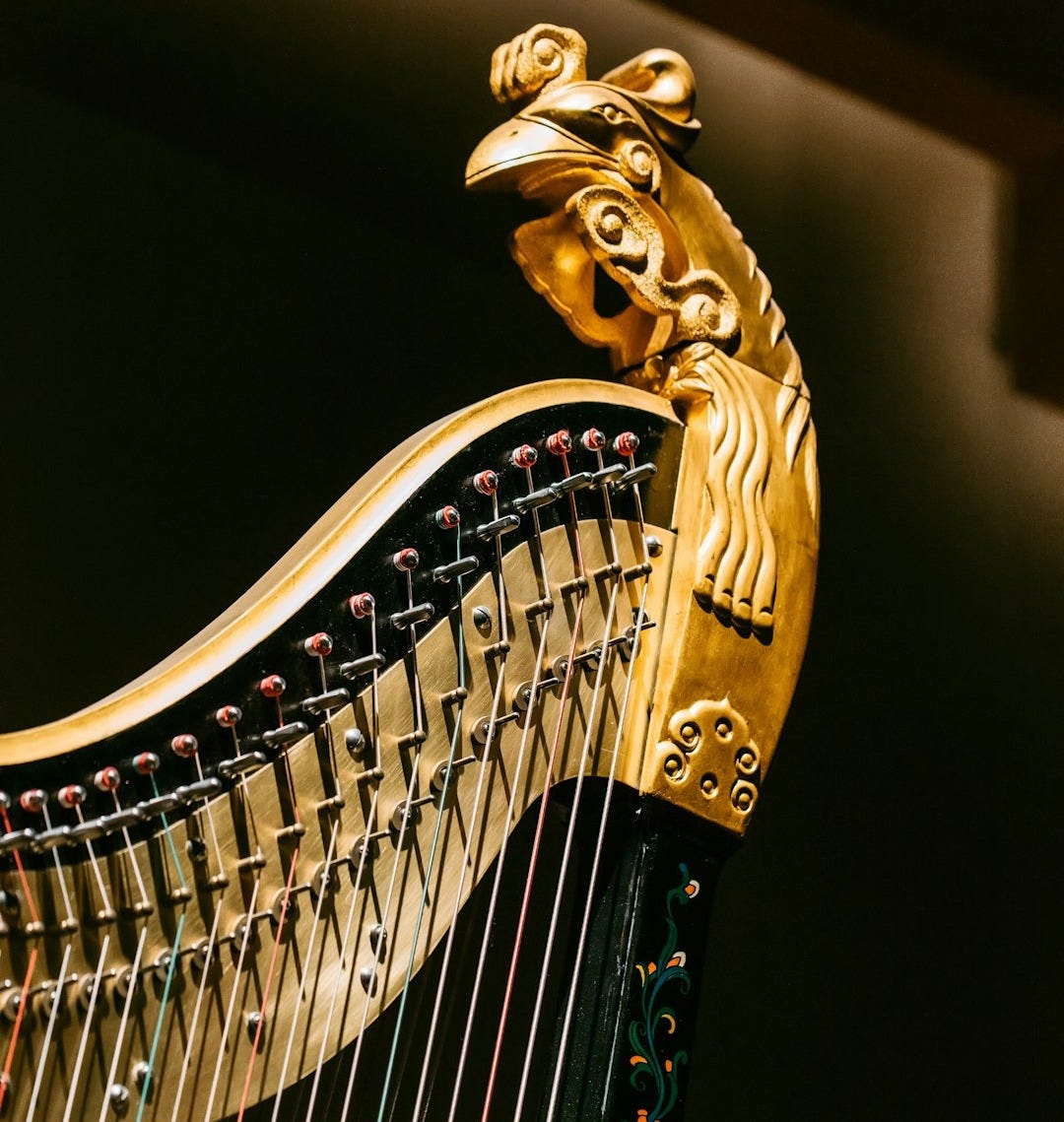
Phoenix went ahead to Achilles’ tents while Odysseus and Ajax the Greater followed on after him, accompanied by Odius and Eurybates. They found Achilles playing a harp he had taken during the raid of Thebe, surrounded by his men and sitting across from his cousin and soulmate, Patroclus.
Achilles and Patroclus both jumped to their feet as Phoenix, Odysseus and Ajax came into view around their circle of men. Their surprise and delight was written plainly on their faces and Achilles greeted them warmly as old friends. He assured them that he was still angry at Agamemnon, but seeing his close comrades after these war-torn days alive and well was balm to his soul.
The party moved inside, into a luxuriously carpeted and furnished tent, urging his visitors to sit while he bade Patroclus rustle up some strong wine and some food. He did so with the help of Automedon, Achilles’ charioteer, and once the meat was well-cooked, Patroclus had prayed over the food and Achilles had given a tribute of the best parts of the meal to the gods, they sat down to feast together after such a time apart.

Once they had eaten, given thanks and were well in their cups, Odysseus forestalled Ajax and Phoenix, who were looking to begin the tricky conversation, and launched into the speech he had prepared from Nestor’s sage advice.
He asked Achilles plainly to come back to the Greek army, spelling out how essential he was to their war effort. They were at a point of life and death, he emphasised, filling him in on the siege the Trojans were temporarily holding overnight until the morning came and Zeus would bless them to victory. Zeus’ support had been a boon to Hector, he said, who had thrown every man he had into the attempt to reach and burn the Greek ships. If dawn came and Achilles had not agreed to join them, Odysseus added, it was sure to spell the end of the Greek army and their nine years of war and siege would end in painful defeat.
He continued on, advising Achilles that if he didn’t take up his arms and fight alongside them as in previous days, the incredible bloodshed would surely only be matched by the regret and sorrow in Achilles’ chest to know that he could have saved his fellow men. Odysseus brought Achilles’ mind back to his father, Peleus, who had said goodbye to his son with a wise piece of advice, or perhaps prophecy, that had warned him to avoid quarrels and to fight for Hera and Athena’s side if he wished to be honoured as a hero. It was not too late, Odysseus pressed, to fulfil his father’s wishes and amend the rift in the army between himself and Agamemnon, if only Achilles would come back.
He finished by informing Achilles of everything, word for word, that Agamemnon had promised should he return to the army, that all those fine riches and the promise of more from Troy could be his, including Briseis back with him again. If he was still so filled with hatred that burned so brightly as to eclipse these things, Odysseus reasoned, then he must think of the men he would be dooming without his aid, that if he came back then they would honour him as a god who walked amongst them. Hector was more vulnerable now than he had ever been, and Achilles was the one among them all who could end him.

Achilles absorbed this great speech and all Odysseus had told him before he readied himself to respond. He wanted anything but to disrespect his friends, and told them so, but had to make them aware of his resolutions in the face of Agamemnon’s offer. He confirmed that his anger was, in fact, still the heat that seared through him hotter than his blood and that he would never return to fight under Agamemnon.
He asserted that it would be impossible to persuade him to join again; it was a thankless task to fight in this war and whether cowardly or brave, the result was always the same, so there would be no value in risking his life for a war that was already decided. It was not, he added, even a war for his wife; Helen was another man’s wife and already so many had died, leaving their own wives in grief for another. He had already destroyed twelve cities with his ships and crew and another eleven on land in these past nine years, and ‘Lagamemnon’ had always taken the finest, so that fighting for those supplies, too, felt meaningless.
They seemed to be doing alright without him, after all, they’d built a wall and moat for protection without his input. He acknowledged that Agamemnon could do nothing about Hector; Achilles had already fought him several times and, though he could, he had no wish to do so again for so little purpose.
He announced that he and his men would be packing up their ships in the morning and leaving for home, heading back to Phthia where his father remained king, waiting for his return. They would sacrifice to the gods for their safe journey and vowed that by early morning, Odysseus and Ajax would be able to see his retreating sails on the horizon.
Never again, he swore, would Agamemnon deceive him; he didn’t trust Agamemnon’s sudden offer of everything he could afford to give. Even if those items of wealth were real, even if they were a city’s worth of riches and resources or enough per every grain of sand on the shore, he would hate them with sheer vitriol until Agamemnon paid in full for the insult he given him by humiliating him in front of the entire army. He would never, he continued, take any of Agamemnon’s daughters either, even if they matched the beauty of Aphrodite or the skill of Athena.
His mother had given him his prophecy and he had chosen a short life of glory over a long life in relative anonymity and peace. He had been foolish to choose such a path, he told them, and his leaving now would give him a chance to go back to that decision and give himself a chance to choose a long life among his father’s people with his wife and son rather than dying on a battlefield for someone else’s pride and someone else’s queen.
He finished with his final piece of advice, that they should take a leaf from his book and return home themselves, able to grow old with their families, rather than to die in their camps in the morning at Zeus’ command, since no man could turn the tide on a god’s decision.
He told them to go, to deliver his unwanted message to Agamemnon and to reconvene, to try and convince the rest of the Greeks to leave while they still could, for he would not go to the king’s side. He offered Phoenix, his beloved and trusted friend, a place in his tent to sleep the night, where he could rest and make the decision in the morning whether he would go back to Agamemnon or safely accompany him back to Phthia.

It was Phoenix’s turn to speak then, with tears in his eyes as he processed Achilles’ refusal, fearing the worst for the soldiers they had left behind at camp. He told Achilles that he had been faithful in his vow to Peleus to teach and protect him, so now he would tell him why he loved him like a son.
His father, Amyntor, had been a cruel man who had favoured his mistress Phthia over his wife, Cleobule, Phoenix’s mother. He regularly insulted Cleobule and shunned her for the attention of Phthia. To get her revenge, Cleobule asked her son to seduce Phthia and consequently enrage Amyntor, which Phoenix did. When Amyntor found out what his son had done, he called to the Furies to curse him so that he may never have children of his own.
Phoenix went to kill his father for his curse but his friends and cousins there held him back, imprisoning him to keep him squarely in the house and standing guard over his rooms night and day. Phoenix, though, intent on escaping the grip of his hated father, slipped out of his room on the tenth night under cover of darkness. He scaled the walls and kept to the shadows to avoid the servants and guards of his home, then made a break for true freedom.
After some small amount of travel he came to Phthia, the unfortunately named region nearby. Its king, Peleus, welcomed Phoenix into his court and treated him as a son, making him the king of Dolopia.

When Achilles was born to Thetis and Peleus, Peleus appointed Phoenix to watch over him and teach him in the ways of men as he grew, together with Chiron. He was also charged with the care and teaching of Achilles when he left Scyros to join Agamemnon and then went on to Troy. He loved Achilles as the son he had never had, the son he could never have, and Achilles in turn had loved him as a father figure. With such tenderness of heart, then, how could Phoenix bear to be parted from Achilles now with an ocean between them?
Brought back to the present from his reveries, Phoenix turned his watery gaze on Achilles, urging him to tame his mighty temper. He reasoned that if the gods could be reasoned with and begged for forgiveness in the great cycle of sin and repentance, then surely Achilles could grant the same to save so many lives.
If Agamemnon was still angry, he added, he would never have thought to side with the king over his beloved Achilles. Still, it remained that the king was begging forgiveness and the offerings he proffered were tantamount to prayers after a sin with Achilles as his god. Even more than this, he had sent his closest friends to parley with him and promised him still more after the taking of Troy.
Odysseus had been right, Phoenix said; if the ships were burned and his friends killed, he would feel nothing but regret and pain. If the gifts were given, surely Achilles could be treated as a god by those who offered, namely the most powerful king in Greece.
Achilles watched his mentor and friend and felt his heart break for him, though he stood tall in his conviction. He consoled him as best he could, but he answered that the honour for a god was not the honour he wanted, that Zeus had already honoured him by bestowing his favour upon him. He gently chided Phoenix not to try and befuddle him with talk of kings, that he should, being dear to him, hate who he hates and stand by him when he was vexed, as he was now. He again urged Phoenix to stay, nodding to Patroclus to make him up a bed, an offer the older man took gratefully.

Ajax took the renewed offer as their cue to leave and he suggested that they depart, acknowledging that clearly tonight was not the night they would get Achilles’ agreement. He did add his own opinion, though, gently reproving his friend that to leave his friends and old comrades to die without his help was indeed hard hearted, especially since they had fought alongside and for him, and to hold this stand all over Briseis, one girl among many they had taken from their raids, felt like folly.
Achilles agreed; he felt the same, but try as he might he couldn’t think of Agamemnon without feeling that surging, boiling anger inside. His humiliation had been so complete that even now, all these days later, he would still have to send them back to deliver their message of disappointment. He was, he confirmed, content not to stir with weapons in hand until Hector came near his camp and his own ships with the threat of burning them, something he strongly suspected would not happen if he stayed out of the fight.
Defeated in this particular battle, Odysseus and Ajax poured out libation for the gods before Odysseus led the envoy party back to the Greek camp. Phoenix stayed behind, with Patroclus already instructing the servants to make him up a bed in the main tent where he would spend the night. Meanwhile, Odysseus and Patroclus slept in their own hut; Odysseus slept with Diomede, a girl he had captured from Lesbos, and Patroclus was alongside Iphis, another captive girl from Scyros.

Returning back to the Greek camp, Odysseus and Ajax reached Agamemnon’s tent, where the leaders had remained in waiting for news. As they entered, the men stood, so eager were they for Achilles’ answer that they had not even set their cups down.
Agamemnon prompted Odysseus to speak at once, so he did. He recounted the evening’s events, telling them that Achilles was still full of passion and anger that had led him to refuse such generous offer. Instead, he had advised them all to sail away from Troy at first light and forget about the war, which he fully intended to do.
Silence fell across the tent as the leaders, princes and kings all absorbed these words.
Again, it was Diomedes who broke it, speaking up at last. He declared that it had been a pity even to ask Achilles back, that he was always a proud man and now he was clearly even prouder still. If the gods intended Achilles to join them, he would. There was now no point in concerning themselves with a man who would leave them to die, so instead they should enjoy the rest of their evening with food and drink and sleep well, for they would need it with the coming of the dawn.
The others cheered in agreement and set about their evenings, making merry while they could in the face of Achilles’ stubbornness and Hector’s impending attack.
Find the seventeenth part of the story of the Trojan War here:
