
Perseus' Story
The complete tale of Perseus' adventures
Content warnings: imprisonment, attempted murder, references to murdering a child, rape, shaming a victim of sexual assault, beheading, body horror, near-sacrifice, accidental death, killing, attempted forced marriage
Reader warning: This post contains rape and outdated standards surrounding sexual assault. You and your safety matter; there are people who would love to give you help if you need it. If you or someone you know have encountered sexual assault or rape, there will be resources local to you. If you’re in Europe, America or Canada, these links can help find resources near you.
This is a post combining all of Perseus’ story into one post. If you’ve read the posts linked below, you’ll have read this story; this post is just to make it easier for you to read the whole story in one place.
Find the individual parts of Perseus’ story here:
Part 1

Part 2

Part 3

King Acrisius of Argos had long been desperate for a son, a male heir to pass his kingdom onto. His wife, Queen Eurydice, had given him a daughter named Danae but still, Acrisius couldn’t find himself contented with his family as it was. Caught between sorrow and frustration in the stark absence of a son, Acrisius undertook the journey to Delphi to consult the wisdom of the Pythia.
He begged the oracle to reveal the gods’ plan for him and whether he would ever be succeeded by his own blood. Duly the Pythia entered her trance and let Apollo channel through her, though the answer to the king’s question was far from anything he’d expected. The oracle told Acrisius that he would indeed have an heir and for a moment his heart soared in his chest, but then she continued on. The heir wouldn’t be his son; instead, he would have a grandson who would succeed him, but she warned that that grandson would kill him.
Now concerned with a risk more dire than his legacy, Acrisius returned to Argos already concocting plans to thwart his eventual end. He built a chamber of smooth bronze underground, leaving only a tiny window for air and light and no handholds to climb the walls. He’d decided that as long as his daughter could never have children, he would be safe from any murderous heir being born in the first place. He locked Danae away in the chamber, confident that nobody would be able to find her, much less enter the chamber to threaten the rule of King Acrisius with any wayward babies.

Danae, distressed and devastated with her new confines, prayed for an end to her imprisonment. Zeus had already heard that Acrisius was doing something strange at his palace, but now the gods were receiving prayers from his daughter begging for her freedom. Intrigued, Zeus descended from Olympus to investigate, especially since he’d heard rumours of Danae’s beauty and would never pass up such a prime opportunity to meddle in mortal affairs.
Finding her trapped in her bronze prison away from the rest of humanity, Zeus transformed himself into a shower of golden rain that fell, dripping, through her small window and into the chamber. He seduced her and they spent hours together, Danae feeling that for the first time in a long while, she wasn’t alone. Soon, however, she realised that she was pregnant and felt a sinking in her stomach; if she was with child, her father’s plan had failed. What would that mean for her if he’d already resorted to locking her away?
Sure enough, Acrisius was astonished to find his daughter pregnant when he visited her after some months. He had been so sure, so certain in his plan, but still the gods had willed that Danae become pregnant. When he heard that Zeus was the father of his grandchild, he became still more panicked. If it had been any old mortal child then he could have taken action, prevented the baby from ever growing up, but since the child was Zeus’ then he could do no such thing for fear of swift and deadly divine retribution. Acrisius nonetheless wanted to be rid of mother and child, so upon Danae’s birth of her son, Perseus, Acrisius put his only possible solution into effect.
He couldn’t keep Danae and Perseus but he also couldn’t kill them, so he left their fate to the will of the gods. He put the pair in a large chest, locked it, then cast it into the depths of the ocean. If they drowned, the gods had allowed their deaths and no responsibility could be put on him. If the gods decreed they live, they would be washed far away enough to no longer be a risk to his life. Satisfied, Acrisius turned his back on the sea and strolled carelessly back inside his palace, his concerns from the oracle finally set aside.
Naturally, Zeus would not allow his lover and their son to die. He summoned Poseidon from his cavernous underwater palace and requested he save them, asking him to set them down on a shore where they would be found and rescued. Poseidon was happy to oblige his brother, directing Danae’s locked chest to float on the water’s surface until it could wash up on the beaches of the island of Seriphos.
A fisherman named Dictys found them, hearing the cries of the baby and mother and hastening to crack the chest open. He helped them out of their imprisonment, bringing them to his home and gently encouraging them back to health after their traumatic trip in the ocean. Danae, Dictys and Perseus became a content little unit in his home, flourishing together and watching Perseus grow up.
Danae and Perseus weren’t Dictys’ only family, however. He had been putting off their introduction to his brother as he knew what kind of man Polydectes was, and he had no wish to expose his new found family to the man his brother had become. At last, after hiding them for some years, Dictys could put off the inevitable no longer. Dictys brought Danae and Perseus, now a strong, athletic young man, to the palace to meet Polydectes, King of Seriphos. As Dictys had known would happen, the moment Polydectes laid eyes on Danae he wanted her as his own, as his wife.

Since her ousting from Argos, Danae had only grown more beautiful in her time living in peace with Dictys and Perseus on the beach. Though King Polydectes was captivated, Danae rejected him outright every time he asked her to marry him, always stressing how little she cared for him. Thankfully, Perseus was now old enough and strong enough to be incredibly capable of protecting his mother from the whims of Polydectes, to the king’s immense frustration. Seeing no immediate way to get Danae all to himself, Polydectes set to scheming instead, biding his time.
One day, out of nowhere, Polydectes announced his engagement to the island but his intended wasn’t Danae; instead, the king was to marry Princess Hippodameia, the daughter of the wealthy King Oenomaus of Pisa. To celebrate the engagement, the whole island was required to bring wedding gifts to the palace. As his near-nephew, Perseus was conscious that he had too little to offer the royal couple but would be expected to gift them something. He went to Polydectes and explained that while he couldn’t afford to buy anything, he would instead offer anything he could go out and find for him.
Even, Perseus joked, the head of the Gorgon, Medusa.
Though Perseus had spoken flippantly, King Polydectes latched onto the idea like a barnacle. Believing that there was no way Perseus would complete this insane task, Polydectes asked him to follow through and behead Medusa, bringing her head back to him as the promised wedding gift. Perseus, desperate for Polydectes to marry another woman and leave his mother alone, agreed. Saying a tender, reassuring goodbye to Dictys and a tearful, fretful Danae, he set sail to find and kill Medusa.
Phorcys and Ceto were sibling spouses, the sea-god offspring of Gaia and Pontus. Together they had many children of their own, most of whom were monstrous creatures and spirits; they had Ladon, a hundred-headed dragon son, Echidna, a female personification of rot with a snake tail and the Graeae, three white sea foam crones who shared one eyeball and one tooth among them. In addition to these strange siblings was another group of three, the Gorgons.
Stheno, Euryale and Medusa were ever-youthful, though that was largely the end of Medusa’s likeness to her two Gorgon sisters. The immortal Stheno and Euryale sported wings of gold, long fangs, sharp claws, scaly skin and a headful of writhing snakes in place of hair. Stheno was the strongest and most independent of the sisters while Euryale was the loudest, with cries deadly to the mortals who heard them. Just looking into Stheno and Euryale’s eyes would cause a human to turn to stone where they stood, so naturally they were feared amongst the human population of Greece for their possession of such lethal gifts.
Medusa, meanwhile, started out as the black sheep of the family; notably mortal, she also shared none of her sisters’ more monstrous appearances. She looked for all the world like any other gorgeous human woman, though her finest beauty was her hair. So unlike her snake-tressed Gorgon sisters, Medusa’s hair flooded over her shoulders and surpassed the already beautiful face she had that set her so apart from the rest of her family. Since she seemed human, Medusa lived amongst the mortals, dedicating her life to Athena as one of her priestesses at her temple on the island of Sarpedon.
Her unexpected natural beauty caught many eyes, though none so dangerous and worrisome as Poseidon’s. Though she was often approached by potential lovers during her work at the temple, Medusa didn’t wish for any such suitors and brushed them off as best she could. The king of the oceans, however, was more of a challenge to get rid of.

Poseidon had noticed Medusa’s beauty when he espied her from the sea near Athena’s temple and decided that he had to have her as his own. One evening, as Medusa prayed to her goddess, the sea god approached her and tried to woo her even while she worshipped another. She tried to turn him down as she had done to many others, but quickly she realised that Poseidon wasn’t asking. Instead, he attacked her in his rage at such an attempt to spurn his advances, taking her where she knelt at the shrine and forcing himself on her. She begged for help and for mercy from any god or mortal who would listen, but nobody came to her aid.
When he was finished with her, Poseidon cast Medusa aside and departed from the temple as suddenly as he had arrived. Bedraggled, violated and traumatised, an isolated and inconsolable Medusa wept for her goddess, imploring her for her help. Athena duly appeared but instead of comforting Medusa, she took one look at her desperate priestess and found no kindness to give her.
Instead, a similar godly rage to Poseidon’s rent the air again, this time from Medusa’s beloved goddess. Athena was appalled that any priestess of hers would defile her temple in such a way, deaf to Medusa’s pleas that frantically tried to explain what had happened, what horrific act Poseidon had committed against her.
Dispassionate and cold, Athena cast Medusa aside just as Poseidon had; where the ocean king had cursed her with two fertile seeds in her womb, Athena cursed her to become alike with her Gorgon sisters. Medusa’s beauty was gone, her oft-admired hair transformed into roiling snakes, her human features replaced with those of Stheno and Euryale, sharp and scaled, fanged and clawed.
Medusa fled from the temple in her horror and shock at such a betrayal, her devotion turning to hatred as she ran, and called for the familiar comfort of her sisters instead. Stheno and Euryale took her in and protected Medusa as much as they could; though she looked like them now, she was still very mortal and was at far more risk than they were from mortal fear and the wrath such fear could cause.
There was one relief Athena’s curse had given Medusa, and that was in her safety from any more gods, men or monsters. No man could look upon Medusa again, whether she wished them to or not; any who saw her would turn to stone, no matter how much they wished to take from her or how much power they had.
Many years on from Medusa’s ordeal at the hands of Poseidon and Athena, the strapping young Perseus had set off from the shores of Seriphos to save his mother from King Polydectes’ advances by delivering him the head of Medusa.
The gods were intrigued by Perseus’ quest; after all, as a poor guest of an island fisherman he had no real armour, weapons or clue as to where to find the Gorgons’ lair. Nonetheless, they watched him depart from Dictys and Danae, firmly intent on his mission. Radiant and cruel Athena, responsible for Medusa’s curse, and mischievous Hermes, always ready to encourage heroes to entertain the gods, appeared to Perseus on his ship as he watched the waving figures of his family fade into obscurity, growing smaller and smaller as the wind picked up and took him gliding across the sea far away from them. His deific visitors told him that Olympus was watching, that the gods were on his side.
Athena, the rising sun glinting off her gleaming armour, entrusted Perseus with her mirrored shield to prevent him from having to look directly at Medusa; she also presented him with a special sack for Medusa’s head. She warned him that even after the Gorgon’s death, her gaze could still turn those it saw into statues. Athena instructed Perseus that once he had succeeded in relieving Medusa’s head from the rest of her body, he needed to put it straight in the sack as it had been magically treated so that her stony stare couldn’t penetrate it.
Hermes stepped forward then, bestowing on Perseus his own winged sandals and an adamantine sword that would make the beheading a clean cut. Then, he reached into a satchel at his side and brought out one final gift; borrowed from the underworld, Hades’ helm of darkness sat in his hands for Perseus to take. Hermes explained that with this helmet, Perseus would become invisible and would be able to move freely without being seen, which the gods hoped would give Perseus enough time to enter the Gorgons’ lair and enough of an advantage to successfully escape when his task was complete.

Though the gods had given him the tools to allow him success, they couldn’t tell Perseus where Medusa was. They were able to tell him, however, where he could find the Graeae, the Gorgons’ sea-crone sisters, who were rumoured to live close to the Gorgons’ lair and would surely know where to find Medusa. Hermes and Athena pointed Perseus toward a dank cave on the Plain of Cisthene that never saw the light of the sun or the moon. The grateful hero thanked them profusely, promising the return of their gifts when he arrived home, head-bearing sack in hand.
Perseus felt their ‘good luck’s rather than heard them and by the time he’d turned back to them, Hermes and Athena had vanished from the deck of the ship, leaving him to undertake his journey to Cisthene alone. He strapped Hermes’ sandals to his feet, stepped from the side of the ship and found himself free to soar above the sea and its myriad islands, heading east to the Plain of Cisthene.
He found the sisters in the depths of their damp cave, surrounded by shallow pools of seawater that had been abandoned by the waves that had long retreated from the cavern. The soaked air hung loose around the Graeae in a way that made it seem as though they may have occupied their space there for aeons; the three women stood before Perseus, clothed in the froth of sea foam that oozed into the puddled, sandy floor. They introduced themselves to their visitor in scratchy, aged voices as Deino, Enyo, and Pemphredo, asking what they might do for a handsome traveller such as himself.
At first they were happy to talk him in circles, trying to trick him into leaving without the information he had come for but Perseus wouldn’t be fooled. Since they only had one eye between them, they squabbled over who got to see the beautiful young man in their cave, all wishing to see him for as long as they could. During one of these arguments, Perseus deftly managed to snatch the eyeball from the air when one crone threw it to another, leaving all three sightless.
He bargained the eye’s return for the location of their Gorgon sisters, using as much charm as he could pile into the negotiation. Reluctantly the Graeae agreed, revealing how to reach the cave of the Gorgons in exchange for their eyeball, which the bickering trio could then only use to watch Perseus slip from their cave and out into the gathering darkness of the evening.
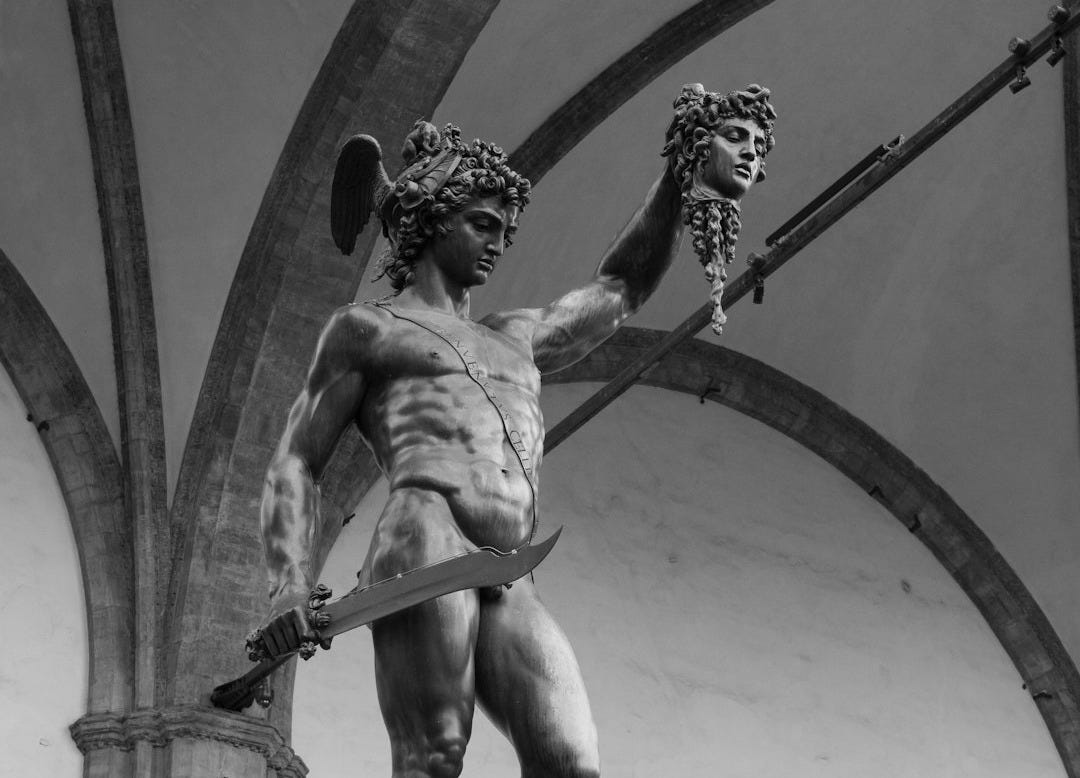
The night had truly fallen when Perseus arrived in Sarpedon, once again soundless in his entrance to the cave the Graeae had directed him to. Donning Hades’ helm of darkness, Perseus crept inside, Hermes’ winged sandals keeping his light footfalls quiet as he eased his way into the cave. He reached a fork in the path with three different offshoots, each with a faint glow of gentle candlelight emanating from deeper within the cavern. He chose the central passage, holding his shield firmly out ahead of him and looking only into the reflection, the wavering light from the chamber ahead growing steadily larger in the curved shield’s perfect surface, guiding him on.
He kept his gaze firmly fixed on the shield until at last he saw the candle that had lit his silent approach. It rested on a stool next to the hollowed out alcove bed of a sleeping, monstrous form. Her hair, had it not been comprised of gently stirring snakes, could have once been lovely, though now her scaly skin, claws and fangs made it obvious that her human-like form had since been stripped away.
Keeping his eyes on the sleeping figure in his mirrored shield, Perseus felt the influence of Athena close by and let her guide his hand as he readied the adamantine sword to fall, slinking as close to the sleeping Medusa as he could. The billowing anticipation of death in the air caused the Gorgon to rouse gently from her sleep; before she could do anything more than start with shock, Athena had loosed Perseus’ blade arm and Medusa’s head was severed from her body in a single strike. Hurriedly, he placed the head in its sack as Athena had advised him, but the body slumped in front of him was already starting to shudder.
With a growing shock, Perseus watched on as the children Poseidon had given Medusa so long ago were at last birthed from their mother’s body. From the stump of her neck emerged Pegasus, a mighty white stallion who unfurled large wings from his back, taking flight as he galloped from the cave. His brother Chrysaor followed, a giant man encased in golden armour and wielding a large golden sword.
Coming back to his senses after such an unexpected pair of births, Perseus felt his stomach fill with dread. Though Medusa was dead, her sisters were still very much alive and, unlike her, were entirely immortal. The births had been loud and there were surely only seconds before the Gorgons were roused from their beds to investigate; without another thought, Perseus gripped the mouth of the satchel tightly closed and sprinted from the cave. Sure enough, it was only moments before the shrieks of the enraged Stheno and Euryale echoed down the passage as they tore after him, but they couldn’t outrun Hermes’ sandals.
As Perseus erupted from the cave, the helm of darkness enveloped him into the invisibility of the cloudless night, shrouding him from the furious eyes of the two remaining Gorgons. He flew up into the sky, soaring higher and higher until, at last, the frustrated cries of Stheno and Euryale faded away into the distance he’d left behind. Perseus was free and alone in the otherwise still heavens, winging his way back over the ocean toward Seriphos and his beloved mother.

On his fleet-footed journey high above the seas, Perseus flew over Aethiopia. It was a beautiful land ruled by King Cepheus and his queen Cassiopeia, though that beauty was marred by the recent attacks of a horrifying sea monster known as Cetus, a brother of the recently-slain Medusa. Like Queen Niobe of Thebes and Arachne of Lydia before her, Queen Cassiopeia had angered the gods by foolishly comparing herself to them, bringing her kingdom its watery onslaught as punishment.
She had had the audacity to describe herself as more beautiful than the stunning nymph daughters of the sea god Nereus, known as the Nereids. The Nereids had heard of Cassiopeia’s heresy and had taken their vicious complaints to Poseidon, the king of the oceans himself. Poseidon, not best pleased with such an insult against any nymphs of his realm, had dutifully sent the whale-serpent Cetus to ravage the shores of the boastful queen and her husband.
The attacks pained King Cepheus greatly as he heard increasing daily reports of the monster’s rampage that left bodies, empty boats and destroyed coastal villages in its wake. Desperate to stop the Cetus, Cepheus sought the guidance of the Oracle of Ammon, who told him that the only way to save his kingdom was to sacrifice his daughter Andromeda to the roaring waves and the Cetus within.
Distraught at such news, the king tried to postpone abandoning his beloved daughter to the ocean for as long as he could. Without her death, however, the monster claimed more lives every day and by the time Perseus flew over Aethiopia, Andromeda had been reluctantly but obediently chained to a rock out at sea where he found the Cetus bearing down upon her.
Perseus was never one to ignore a damsel in distress and quickly swooped down, pulling out Medusa’s head from its sack as he went. He pulled up her eyelids with a swipe and froze the Cetus into stone in a moment, the tide of water it brought with it crashing down over them both. As the ocean settled back around their small rocky platform, the newly-stone monster began to sink, embedding itself onto the sandy sea floor for good.
Carefully stowing the head back into its protective bag, Perseus made quick work of the chains keeping Andromeda trapped on the rock and helped her up, introducing himself. He listened to her story, reassuring her that he would return her home as quickly as he could with his god-given winged sandals. Ready to depart, Perseus gave Andromeda a warm smile and lifted her easily into his arms, leaping into the air and soaring back up into the sky. He carried her back to the palace and delivered her safely back to her parents, who were ecstatic to see their daughter alive and unharmed.
In gratitude for such an act of bravery, Cepheus offered Perseus Andromeda’s hand in marriage should he wish for it; both were delighted to accept each other and were excited to wed as soon as they could. Cepheus was only too happy for his treasured daughter to marry such a hero as Perseus but there was a small something he’d forgotten: Andromeda had already been promised to his brother, Phineus.
Phineus was outraged at his brother’s change of heart, desperate as he was to have his young, beautiful niece for a bride. Not content to be so easily forsaken, Phineus gathered a mass of followers and brought them, uninvited, to the wedding feast. He barged into the room, smugly satisfied to see that his raiding party significantly outnumbered the wedding guests. He announced his intention to take Andromeda for himself as he had been promised, only reclaiming what he believed to be his.
Perseus saw his bride’s distress at the prospect of being ripped away from her groom and her parents, so he warned his new family to look away and tore Medusa’s head from its bag once more. In a second, a stony ripple of horror overtook Phineus and his men, each staring in terror as they froze before their very eyes. In a heartbeat, the wedding was left in a shocked silence and the company of the dreadful statues, each trapped in a muted scream where they stood.

The freshly-married Perseus and Andromeda departed Aethiopia shortly after their eventful wedding, the hero carrying his new wife in his arms once again. The blood from Medusa’s head had been pooling in the bottom of the magical bag for some short while and now it had at last seeped through the sturdy material. As Perseus flew his love home, the blood from the sack attached to his belt fell down to earth; where the blood landed in the Sahara, venomous vipers sprang into life, while in the Red Sea, the blood blossomed and birthed corals.
Finally touching down in Seriphos, Perseus was excited to introduce his new wife to his mother Danae and surrogate father Dictys. However, reaching Dictys’ home on the island’s shores, they found the fisherman distraught. Though overjoyed to see Perseus alive and well, Dictys had terrible news: from the moment of Perseus’ departure, Polydectes had forgone his ‘engagement’ to Hippodameia, who had never known of such a scheme, and began harassing Danae.
Polydectes had gloated to Dictys of how Perseus would never return and could no longer stop him from having the woman he really wanted. The king had harried Danae in the hours that Dictys was out at sea, eventually taking her against her will to the palace when she wouldn’t come willingly. Dictys explained to Perseus how he had tried to get her back, how he had pleaded with his brother to let Danae free but that Polydectes wouldn’t hear of such a thing. With a brow furrowed by guilt and worry, Dictys delivered the final blow of Polydectes’ wicked plan: Danae and Polydectes were to be married in the next few days and Perseus would likely never be able to help his mother escape the vile king if the wedding came to pass.
Perseus felt a familiar disgust at Polydectes’ shamelessness and indecency, feeling it intermingling with rage. He thanked Dictys for his efforts in trying to stop Polydectes, assuring him that he would fix the situation. Perseus also introduced a newly hopeful Dictys to Andromeda, asking him to keep her safe while he went up to the palace, promising both that he would be careful.
On the well-worn path to Polydectes’ palace, Perseus let the ire at such ill-treatment of his cherished mother burn through him, feeling the angry heat course through his veins. Reaching the sprawling villa, he barged into the feasting hall to find Polydectes and his sycophantic followers drunkenly celebrating the upcoming nuptials. Ripping the Gorgon’s head from its satchel for a final time, Perseus stood firm and displayed the king’s hard-won wedding gift for all to see and, more importantly, for it to see them.
He looked on callously as the entire hall of revellers solidified into stone, each one feeling their skin harden around lungs that refused to expand and hearts that ceased to beat. These statues would linger, eroding away with time until their features were all but a memory, the people of the island insisting that the unfortunate merrymakers were the boulders since scattered across Seriphos.
The threat to Danae gone, Perseus searched the palace for his mother and joyfully reunited with her at last. She, like Dictys, was elated to see her son again, tearfully greeting him with the love of a mother convinced that her only child was gone for good. He explained that Polydectes would never be a problem again and accompanied her, victorious, back home, where he could introduce her to his new wife.
During the jubilant celebrations of their little family that evening, Perseus wandered further down the beach for a moment alone with himself. As though they’d been waiting for such an opportunity, the golden glow of the gods preceded Athena and Hermes for only a moment before they stepped from the light to greet him.
Perseus thanked them fervently; without their gifts, he couldn’t be sure that he would have been able to complete his adventure. He gratefully returned the sandals, helm, sword and bag, complete with Medusa’s head inside. Athena was thrilled, incorporating the head onto her aegis shield as the ultimate weapon against her foes. She also confided in a horrified Perseus that she was developing a double pipe, named an aulos, to mimic the distressed screams of Medusa’s sisters when they discovered her decapitated body. Hermes just shook his head at his half-sister’s enthusiasm, shooting Perseus an apologetic smile as he ushered her away.

In the days that followed his triumphant return, Perseus installed Dictys in Polydectes’ place as the new king of Seriphos. Before long, the palace was cleared of its wretched statues and the island had settled again, falling back into the rhythms of everyday life once more after such a brief and exciting change of power.
Perseus and Danae saw their friend’s contentment and decided that it was time to return home to properly address their own royal kin and their problems. Together with Andromeda, the little family set out on a ship bound for Argos. On hearing of his offspring’s impending return, King Acrisius fled his own kingdom for Thessaly before Perseus would get a chance to dock in Argos, desperate to outrun his dreaded and fateful prophecy.
Perseus, Andromeda and Danae found Acrisius’ throne empty and joined Danae’s mother, Eurydice, at her husband’s palace with Perseus finally taking his rightful place as the heir to the throne of Argos. Neither hide nor hair was seen of Acrisius in Argos for some months, though he wouldn’t remain safe from his prophecy for long.
A grand funeral was to be held in the Thessalian capital city of Larissa, where Acrisius had taken refuge, for the newly-deceased King Amyntor of Ormenium. Both Acrisius and Perseus were invited to pay their respects, so Perseus dutifully boarded his ship once again and set off for Thessaly, feeling the significance of every mile he travelled closer to his grandfather.
During the events held in King Amyntor’s honour Perseus couldn’t find Acrisius anywhere, strongly suspecting that the old man was hiding from and avoiding him. In the meantime, the young prince took part in the traditional funeral games and hurled a discus but by a fluke — or perhaps the will of the gods — the discus accidentally hit Acrisius, killing him there and then.
The long-feared prophecy had come true, leaving a distressed Perseus who had never met his grandfather, a man whom he’d certainly never wished dead but had managed to kill regardless. On his return to Argos with a deep-seated anguish, Perseus refused to take the throne despite being Acrisius’ heir; he didn’t feel right in benefitting from his grandfather’s death, so instead he came up with an alternative.
Before Perseus was born, Acrisius’ brother Proetus had taken over a portion of Acrisius’ kingdom as his own and had settled in Tiryns. Though a significant amount of land, Proetus’ kingdom was still smaller than Acrisius’ and Argos had flourished under Acrisius’ reign, making his the far more successful kingdom. Since then, Proetus had died and his son Megapenthes had inherited the throne.
Perseus approached Megapenthes with a proposition; he didn’t want the throne of Argos, so he suggested that Megapenthes take Acrisius’ throne and Perseus take Megapenthes’, swapping their kingdoms. His cousin was only too happy to take over Acrisius’ prosperous kingdom, allowing Perseus to inherit his title in the smaller kingdom of Tiryns and Midea without profiting from his deadly accident in Larissa.
Perseus decided to begin afresh with his new kingdom, building a new capital city named Mycenae with the help of the Titan Cyclopes, as they were the only beings capable of lifting the enormous blocks that made up the walls and gates of the city, each being 8ft wide. Under the rule of Perseus and Andromeda, Mycenae would become one of the most powerful cities in the Greek world, as well as one of the most historically significant.
Together, the royal couple had nine children. Two were daughters, Autochthe and Gorgophone, while seven were sons, Alcaeus, Heleus, Mestor, Sthenelus, Cynurus, Electryon and finally Perses, who would grow up to be the father of the Persian kings. Perseus and Andromeda, unlike many such significant figures as them, would enjoy a largely happy life and die of old age, succeeded in their thrones by their son Electryon.
After their deaths, both Perseus and Andromeda were celebrated by the gods and were raised up to the heavens as constellations close to each other, joining Andromeda’s mother Cassiopeia near the north pole. Her placement was a continued punishment for her hubris even after Cetus’ death, however, as Poseidon chained the queen to her throne and forced her constellation to rotate around the north star, humiliating her as she is often seen to be upside-down.
