
Blind Sight
The price of prophecy and the games of the gods
Content warnings: blinding, animal harm, sexual themes, death

Athena had many nymphs who accompanied her frequently, though none were so treasured as Chariclo, one of the many Oceanids. The pair were rarely seen apart, the closest of friends and confidantes.
Chariclo had met and had a dalliance with a shepherd named Everes, a descendant of Udaeus, one of the Spartoi of Thebes. Together, Chariclo and Everes had a son, a boy named Tiresias. For the first few years of his life, he seemed to be a happy child who loved being in the company of his mother and her goddess.
One day in his mid-teens, Tiresias and his hunting hounds were out roaming the land on a scorching hot day, the heat pressing close to their skin. To find some relief, he decided to climb down Mount Helicon, where he was hunting, and get a drink from the clear waters of Hippocrene Spring, perhaps even taking a cooling dip.
He and his dogs found the spring and took solace in its running water, the dogs splashing with joy in their brief reprieve from the heat. Unbeknownst to Tiresias, his mother was further upstream with Athena, the pair having had the same idea to cool themselves off from the oppressive heat. Wading into the rush of the water, he spied a glimpse of the two before he could realise that they were naked.
Athena, sensing uninvited eyes on her and her friend however briefly, cursed the watcher, bringing instant blindness to Tiresias; no mortal could possibly be allowed to look upon a god’s naked form without their permission. Recognising the trespassing youth as her son, Chariclo rushed downstream to comfort him. On reaching him, she realised what Athena had done and Chariclo rounded on her, angry and panicking for her child; she begged the goddess to take back the punishment, reasoning that it was too harsh for such a simple mistake.
Athena apologised frantically, at once regretting her haste and the distress it had caused, but told the mother and son that she couldn’t undo the damage to Tiresias’ sight. She could, however, give him gifts to recompense him for his loss. She blessed him with the ability to see the future; he would become the greatest diviner in the world, the ultimate Seer of Apollo, the god of prophecy. She also gave him a staff of cornel wood that would allow him to traverse the land as though he could see, along with the ability to understand birdsong —later, he would also be credited with the first use of augury, the use of bird entrails to divine the future. On top of these gifts, Athena promised him a long life and that when at last death came for him, he would keep his mind and his prophetic talents even in the underworld, honoured by Hades among the dead.
She told Tiresias and his mother that he would be sought out by kings and generals, that he would consult on the most important matters, as well as the trivial. It was true that Tiresias would become legendary; he was consulted by kings and paupers alike, though often his oracles weren’t fully understood or believed. He would often speak in riddles, obscuring his facts in a shroud of complex verbiage.
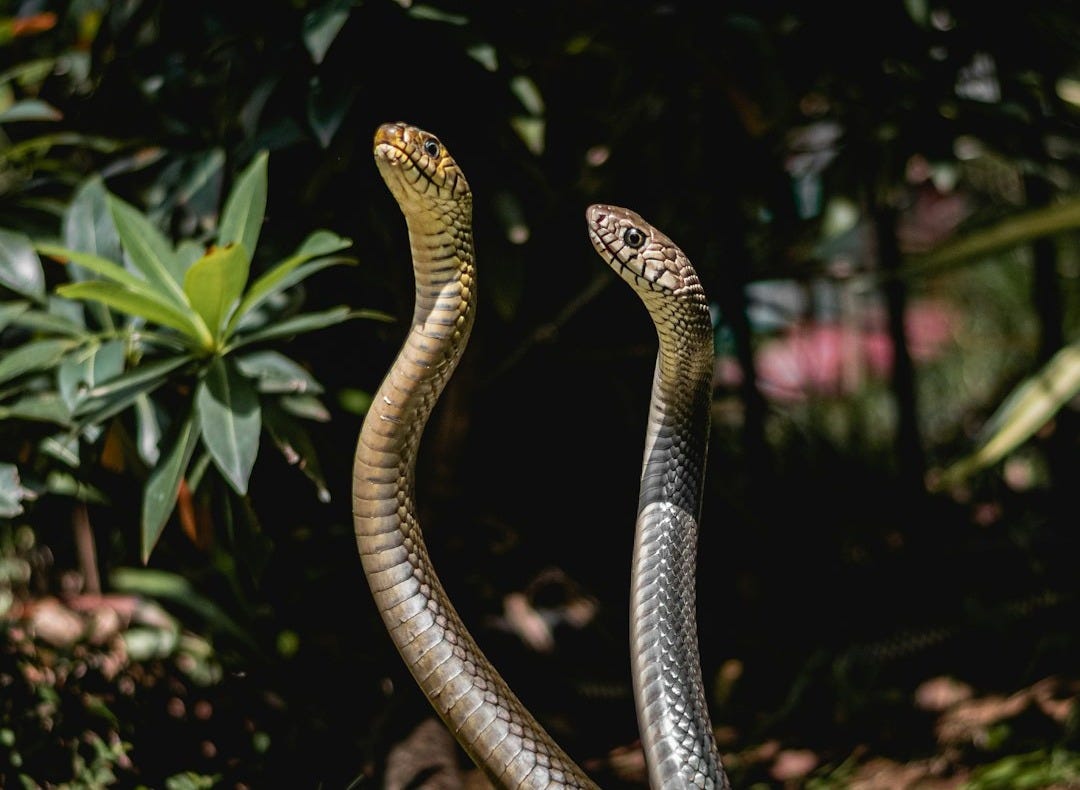
Some years later, having established himself as an indomitable and trustworthy seer, Tiresias was roaming through the countryside in and around Thebes. On this occasion, he was in the area of Mount Cithaeron when he came across two mating snakes. Repulsed by this behaviour, he struck out toward the snakes with his staff, wounding the female.
At once, Tiresias sensed a divine presence before him. Hera, goddess of families and marriage, had found his interruption of such an act of nature egregious and came down from Olympus to punish his momentary violence. She turned him from male to female, his usually flat planes becoming softer and curvier. Newly transformed, Tiresias headed back toward Thebes to begin her female life there.
She soon found refuge and sisterhood at the temple of Hera in Thebes, dedicating her new life in service as a priestess to the goddess who had changed her. Tiresias spent seven years there, during which she married and had three children, Historis, Daphne and Manto. Manto would, in time, set up her own oracle in Clarus and become a famous seer in her own right, her mother’s powers flowing through her to strengthen her connection with the gods.
At the end of seven years as a female priestess of Hera, Tiresias was once again walking the area of Mount Cithaeron and happened upon the same two snakes mating. She had had an oracle prediction of her own from Apollo during her time at the temple; he had told Tiresias that when she found the snakes again, she must injure the male snake this time and Hera would restore her masculinity. Tiresias struck out once more at the snakes, injuring the male of the pair; as promised, Hera smoothed out the feminine curves she had given him into the familiar body he had grown up in.
Some years later, Zeus and Hera got into an argument, as was a fairly common occurrence on Olympus. This time, the conversation had turned to sexual pleasure. Zeus was arguing that women got more pleasure from sex, whereas Hera retorted that men had the most pleasure instead. As the only one alive who could definitively solve this debate they summoned Tiresias, now restored to his male form, to give his opinion on the subject, which he did frankly and clearly.
‘Of ten parts a man enjoys one only, but a woman enjoys the full ten parts in her heart.’
He ruled that women enjoyed sex significantly more than men did. In alternative versions of the story, this is when Tiresias is blinded in a rage by Hera at his revealing such feminine secrets, with Zeus giving him the gifts of prophecy and a long life in gratitude for his honesty.

Tiresias lived for a long time with his extended life courtesy of Athena, outliving seven generations of Theban residents who had turned to him for their deific advice. He operated at the oracle there, doling out prophecies from Apollo at his visitors’ requests. These visitors would often be prestigious just as Athena had promised, making oracles for Narcissus, Amphitryon, Oedipus and Creon, among many others.
This safe and steady existence lasted as long as Thebes and no further; when Thebes was attacked and the city burned, the residents fled. Having given all the prophecies he could to fruitlessly try and stop the war, Tiresias ran along with them, as far and as fast as his now extremely geriatric legs could carry him.
Some way along the road, he stopped at Telphusa Spring on Mount Tilphusius to wet his parched throat, but the water had been still for a long time before his approach. It had grown fetid and infected, and drinking it almost immediately killed the great prophet, choking on the infestation in the water.
It wasn’t over for Tiresias, however. As Athena had promised all those years ago, Tiresias was allowed to keep his prophetic abilities even in death. Persephone ensured that Athena’s vow came to fruition, granting Tiresias the sanity he had held during his life, as well as the freedom and power to roam the Meadows of Asphodel. He was perfectly able to speak with any living visitors to the underworld, not needing the traditional sacrifice of blood to be able to speak and be spoken to by the living.